

Introduction: Automation Is Not the First Step
Many businesses want automation because they are tired of manual work.
They want fewer repeated tasks, faster replies, better tracking, cleaner customer communication, fewer missed opportunities, and less daily pressure on staff. That is understandable. Manual work can be slow, expensive, inconsistent, and frustrating.
But there is one mistake that many businesses make:
They try to automate before they understand the workflow.
That is where automation becomes dangerous.
Automation does not automatically make a business organized. It does not fix unclear responsibilities. It does not repair a weak intake process. It does not clean messy data. It does not solve poor communication. It does not replace missing decision rules. It does not magically turn a scattered operation into a structured system.
If the process is messy, automation often makes the mess move faster.
A broken workflow done manually is already a problem. A broken workflow automated at speed can become a bigger problem.
That is why businesses should not start with the question, “What can we automate?”
They should start with a better question:
What workflow are we trying to improve, and what result should it produce?
Before automation, the business needs clarity. It needs a clean process. It needs clear handoffs. It needs reliable data. It needs defined responsibilities. It needs a practical system that people can actually follow.
Only then does automation become useful.
What Workflow Automation Actually Means
Workflow automation means using software, systems, rules, integrations, notifications, forms, CRM updates, dashboards, or AI-assisted tools to move work from one step to the next with less manual effort.
In simple terms, automation helps a business make sure that the right action happens at the right time.
For example:
- A website inquiry can automatically create a CRM record.
- A lead form can notify the correct team member.
- A missed call can trigger a follow-up message.
- A quote can move into a follow-up pipeline.
- A project request can be logged into a dashboard.
- A customer update can be sent without someone manually typing the same message every time.
- A task can be assigned when a specific condition is met.
- A report can summarize activity from a form, sheet, CRM, or internal system.
This is useful.
But automation only works well when the business already knows what should happen.
If the team does not know who handles new inquiries, automation cannot decide that safely. If the business has no clear sales stages, automation cannot maintain a meaningful pipeline. If every team member follows a different process, automation will either break or create confusion. If the data entering the system is incomplete, the automation will produce incomplete results.
Automation is not the process itself.
Automation is the engine that helps the process run.

Why Businesses Rush Into Automation Too Early
Businesses usually do not rush into automation because they are careless. They rush because they are under pressure.
Common reasons include:
- Staff are overloaded.
- Owners are handling too much manually.
- Leads are slipping through the cracks.
- Customers are waiting too long for replies.
- Internal communication is scattered across phone calls, messages, emails, and spreadsheets.
- Repeated admin work is consuming too much time.
- Managers do not have a clear view of what is happening.
- Teams are making mistakes because there is no standard system.
- Growth is exposing weak operations.
At that point, automation feels like the obvious solution.
But if the business skips workflow cleanup, it may automate the wrong thing.
For example, a company might create an automated email follow-up sequence before defining which leads should receive follow-up, when they should receive it, and what message is appropriate based on their stage.
Another company might automate internal task assignment before clarifying who is responsible for each type of request.
Another may connect a website form to a spreadsheet or CRM, but the form asks weak questions, collects incomplete information, or sends every inquiry to the same person with no priority rules.
That is not smart automation.
That is digital clutter.

The Damage Caused by Messy Workflows
Messy workflows quietly damage a business every day.
The damage does not always appear as one big failure. It usually appears as repeated small leaks.
A delayed reply here. A missed message there. A customer asking the same question twice. A manager checking three different tools to understand one job. A team member waiting for approval. A lead forgotten in an inbox. A quote sent with no follow-up. A task assigned without context. A report built manually at the end of the week because the data was never captured properly.
These leaks add up.
1. Lost Revenue
When inquiries are not captured properly, leads get missed. When follow-up is inconsistent, interested prospects go cold. When quotes are not tracked, sales opportunities disappear. When the owner has to remember every customer manually, the business becomes dependent on memory instead of systems.
That is not scalable.
A business does not only lose money because demand is low. It also loses money because demand is handled badly.
2. Slower Customer Response
Customers expect speed.
If a business takes too long to respond, the customer may move on. This is especially true for service businesses, project-based companies, consulting companies, construction-related businesses, technology companies, and any business where customers compare multiple providers.
Slow response is often not caused by lazy staff.
It is caused by unclear workflow.
Nobody knows who should reply. The inquiry is sitting in the wrong inbox. The form did not collect enough information. The CRM was not updated. The staff member needs to ask someone else. The owner has to approve everything. The customer waits.
Automation can help, but only if the response workflow is clear first.
3. Staff Overload
Messy workflows create unnecessary mental load.
Employees spend time asking:
- Where is the information?
- Who is responsible?
- Did anyone reply?
- Has this been approved?
- What is the next step?
- Which version is correct?
- Was this already done?
- Where should I record this?
This type of work is exhausting because it does not feel productive. It is not strategic. It is not creative. It is not customer value. It is coordination friction.
When staff spend too much time searching, checking, confirming, repeating, and chasing, the business becomes slower even if everyone is working hard.
4. Poor Management Visibility
A business owner or manager cannot improve what they cannot see.
If inquiries are in email, customer notes are in messages, tasks are in someone’s head, project status is in a spreadsheet, and follow-ups are not tracked anywhere, the business has no real operational visibility.
Without visibility, managers make decisions based on feelings.
They may think leads are low when the real issue is poor follow-up. They may think staff are slow when the actual issue is unclear handoff. They may think customers are difficult when the actual issue is weak communication. They may think they need more people when they actually need a cleaner system.
Good workflows create visibility.
Automation then turns that visibility into action.
5. Inconsistent Customer Experience
Customers notice inconsistency.
One customer receives a quick reply. Another waits two days. One receives a clear next step. Another receives vague information. One gets a professional follow-up. Another gets forgotten. One project is documented well. Another is handled through scattered messages.
This damages trust.
Consistency is not created by telling people to “do better.” Consistency is created by designing a workflow that makes the right action easier to repeat.
6. Bad Data and Weak Reporting
Automation depends on data.
If the business does not collect the right information at the right step, reporting becomes weak. The team may not know where leads come from, which service gets the most inquiries, how long follow-up takes, which stage creates delays, or which tasks are repeated most often.
Without good data, automation can still move information, but it cannot create useful intelligence.
A messy workflow produces messy data.
Messy data produces weak decisions.
The Core Rule: Fix the Workflow Before You Automate It
Before automating a process, the business should map the current workflow.

This does not need to be complicated. It can start with simple questions:
- What starts the process?
- Who receives the request?
- What information is needed?
- What decision needs to happen?
- Who is responsible for the next step?
- What should happen if the customer replies?
- What should happen if the customer does not reply?
- Where should the information be stored?
- What status should be visible to the team?
- What result should the process produce?
This exposes the real problems.
Sometimes the business does not need automation first. It needs a better form. Sometimes it needs clearer roles. Sometimes it needs a CRM cleanup. Sometimes it needs fewer tools. Sometimes it needs a dashboard. Sometimes it needs standard reply templates. Sometimes it needs a new approval process. Sometimes it needs a documented handoff.
Automation should come after this clarity.
What Good Workflow Design Looks Like
A good workflow is simple enough to use and strong enough to control the business process.
It should include:
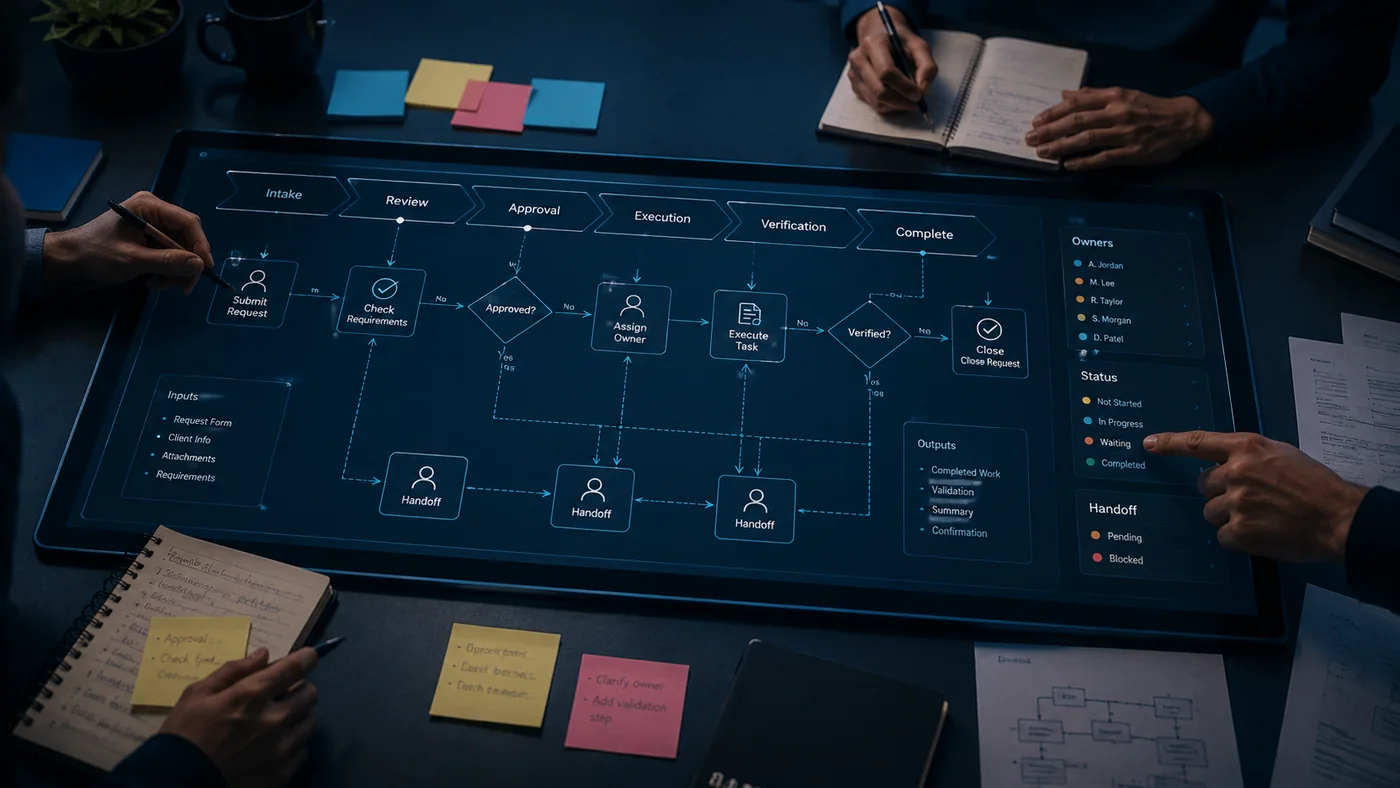
Clear Trigger
Every workflow starts somewhere.
A trigger could be a website form submission, a phone call, an email, a project request, a payment update, a support ticket, a new customer record, or an internal task.
The trigger must be clear because automation needs to know when to begin.
Clear Ownership
Every process needs an owner.
If nobody owns a step, it will eventually fail. If too many people own it, everyone assumes someone else is handling it.
A good workflow defines who is responsible at each stage.
Clear Information
The workflow should collect the information required to move forward.
For a lead workflow, this might include name, contact details, service type, urgency, location, budget, timeline, and message.
For a project workflow, this might include project type, scope, documents, deadline, approval status, responsible person, and next action.
Weak information creates delays.
Clear Decision Rules
Automation often depends on conditions.
For example:
- If the inquiry is urgent, notify the team immediately.
- If the customer does not reply in 24 hours, send a follow-up.
- If the form is incomplete, request missing details.
- If the project is approved, create a task.
- If the lead is outside the service area, send a polite decline or alternative instruction.
- If payment is overdue, send a reminder.
These rules must be defined before automation is built.
Clear Status Tracking
A workflow should show progress.
Examples:
- New inquiry
- Contacted
- Waiting for customer
- Quote sent
- Follow-up needed
- Approved
- In progress
- Completed
- Closed
Without statuses, people have to ask for updates manually.
Clear Exception Handling
Not every case follows the standard path.
Good workflows define what happens when something goes wrong.
Examples:
- Customer gives incomplete information.
- Team member is unavailable.
- File is missing.
- Lead is urgent.
- Customer complains.
- Payment fails.
- Approval is delayed.
- Request does not match normal service categories.
Automation should not ignore exceptions. It should route them properly.
Where Automation Helps Most
Automation is most valuable when the task is repetitive, rule-based, time-sensitive, data-driven, or easy to forget.
Strong areas for automation include:

Lead Capture and Inquiry Management
A website form or inquiry channel can send data into a CRM, spreadsheet, dashboard, or notification system. The business can track who contacted them, what they need, where the lead came from, and what should happen next.
CRM Updates
Automation can update customer status, assign owners, create tasks, log form submissions, and move leads through stages.
Follow-Up Workflows
Many businesses lose opportunities because follow-up depends on memory. Automated follow-up can help remind customers, reopen conversations, and keep sales or project communication moving.
Internal Notifications
When important events happen, the right person can be notified automatically. This reduces delays and prevents tasks from sitting unnoticed.
Task Assignment
If a request meets certain conditions, the system can create a task and assign it to the right person.

Reporting Dashboards
Automation can feed data into dashboards so managers can see inquiry volume, response status, pending tasks, project stages, and bottlenecks.
Documented Handover
When a process moves from one person or department to another, automation can pass key details forward so the next person does not start blind.
Why AI Does Not Remove the Need for Workflow Design
AI makes this topic even more important.
Many businesses now use AI tools for writing, summarizing, answering, drafting, analyzing, or assisting with repetitive tasks. AI can be useful, but AI without workflow design can create new problems.
If AI is used without clear rules, the business may face:
- inconsistent messages
- unclear ownership
- duplicated work
- wrong assumptions
- weak data security practices
- unreviewed outputs
- overdependence on tools
- poor handoff between humans and software
AI should be placed inside a workflow, not randomly added around it.
For example, AI can help summarize a customer inquiry, but the workflow still needs to define where that summary goes, who reviews it, what action follows, and what information must be stored.
AI can help draft a reply, but the business still needs tone guidelines, approval rules, customer context, and exception handling.
AI can help classify leads, but the business must first define what a good lead means.
AI is powerful when the workflow is strong.
AI is risky when the workflow is unclear.
What Results Can Be Seen After Better Workflow Implementation
Better workflows do not only make the business look organized. They change how the business operates.
The exact result depends on the business, but common improvements include:

Faster Response Time
When inquiries are routed correctly and next steps are clear, customers can receive faster replies. Staff do not need to search for information or ask who should respond.
Fewer Missed Opportunities
With better capture, tracking, and follow-up, fewer leads fall through the cracks.
Less Manual Repetition
Repeated admin tasks can be reduced through forms, templates, CRM updates, notifications, and reporting automation.
Better Team Coordination
When responsibilities and handoffs are clear, staff spend less time chasing updates and more time doing useful work.
Cleaner Customer Communication
Customers receive more consistent updates, clearer next steps, and fewer confusing messages.
Stronger Management Visibility
Owners and managers can see what is happening without asking everyone manually.
They can understand:
- how many inquiries came in
- which ones need action
- which quotes are pending
- where delays happen
- which tasks are overdue
- what the team is handling
- what needs improvement
Better Data for Decision-Making
When the system captures information properly, the business can make decisions based on real data instead of assumptions.
Easier Growth
A business with weak workflows becomes harder to manage as it grows. More customers, more staff, more services, and more projects create more complexity.
A business with clean workflows can grow with more control.

A Practical Workflow Cleanup Framework
Before building automation, a business can follow this simple framework.
Step 1: Audit the Current Process
Identify how work currently moves.
Where does the request begin? Who handles it? Where is the information stored? Where does the process slow down? What gets repeated? What gets forgotten?
Step 2: Identify Bottlenecks
Look for points where work waits, repeats, fails, or becomes unclear.
Common bottlenecks include approvals, missing information, unclear ownership, poor customer response tracking, and scattered communication.
Step 3: Define the Ideal Workflow
Design the cleaner version.
What should happen first? What should happen next? Who owns each step? What information is required? What status should be visible?
Step 4: Standardize the Process
Create consistent fields, statuses, templates, rules, and responsibilities.
Do not automate yet if the process is still unclear.
Step 5: Automate the Right Parts
Now decide what should be automated.
Good automation usually handles repetitive actions, reminders, routing, logging, notifications, updates, and reporting.
Step 6: Test Before Expanding
Run the workflow with real examples.
Check if the automation triggers correctly, if the data is useful, if the team understands it, and if customers receive the right communication.
Step 7: Improve Over Time
Workflows are not finished forever. They should be reviewed as the business changes.
Signs Your Business Needs Workflow Cleanup Before Automation
A business probably needs workflow cleanup if any of these are true:
- Leads are handled differently depending on who sees them first.
- Customer information is scattered across email, chat, spreadsheets, and phones.
- Staff ask the same internal questions repeatedly.
- The owner has to manually remind everyone what to do.
- Quotes or proposals are sent but not tracked properly.
- Follow-up depends on memory.
- Managers cannot quickly see what is pending.
- Reports are built manually every week or month.
- Customers ask for updates because they were not informed.
- A new employee would struggle to understand how work gets done.
- The business uses many tools, but they are not connected.
- Automation exists, but people still work around it manually.
If these problems exist, adding more automation without process cleanup will not fix the business.
It may only create a more complicated mess.
How Axton Group Helps Businesses Build Better Workflows
Axton Group helps businesses plan, build, and improve digital systems that support clearer operations.
The goal is not to add automation for the sake of automation.
The goal is to understand the business problem, clean the workflow, and then build the right digital support around it.
Depending on the project, this can include:
- workflow audit
- website inquiry and contact form planning
- CRM and lead management structure
- Google Sheets or database logging
- internal dashboard planning
- task routing and notification setup
- automation planning
- software or web system planning
- SEO, AEO, and GEO structure for visibility
- documentation and handover
- improvement roadmap
Axton Group can help businesses move from scattered manual work to a cleaner digital system where inquiries, tasks, customer communication, and reporting are easier to manage.
The process usually starts with understanding what is currently happening, where the bottlenecks are, and what outcome the business wants.
Then the system is planned around the workflow.
That is the right order.
First: understand the work.
Second: improve the workflow.
Third: automate the parts that should be automated.

Conclusion: Automation Should Create Control, Not Confusion
Automation can be powerful.
It can save time, reduce repeated work, improve response speed, support better reporting, and help teams operate with more consistency.
But automation is not the foundation.
Workflow clarity is the foundation.
A business that automates too early may end up with more tools, more notifications, more confusing dashboards, and more disconnected systems.
A business that cleans the workflow first can automate with purpose.
The question is not simply:
“Can this be automated?”
The better question is:
“Should this workflow exist in this form, and what should happen at every step?”
Once that answer is clear, automation becomes much more valuable.